Frequency Sweep Generator
Start quiet. Keep volume low; loud tones or noise can harm hearing or speakers. Not a medical device.
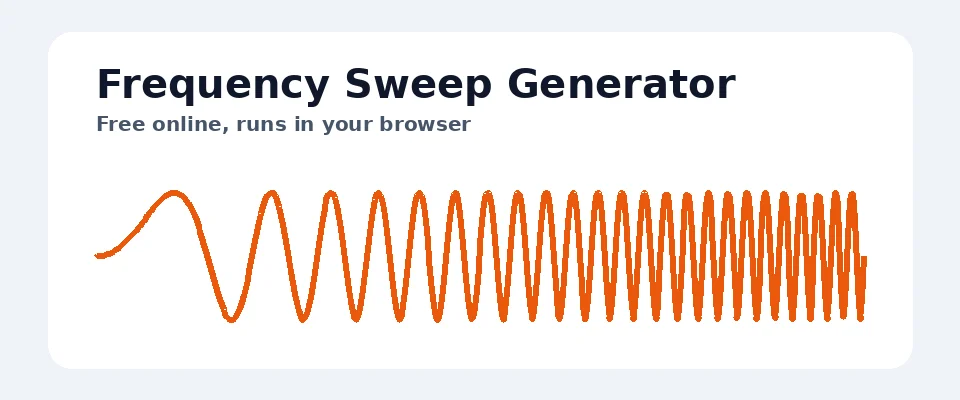
A logarithmic sweep spends equal time on each octave, which sounds even to the ear.
Listen for rattles, buzzes or sudden drops to find resonances and weak spots in speakers or rooms.
Sweep tone from 20 Hz to 20 kHz
This frequency sweep generator glides a tone smoothly from a start to an end frequency over the time you choose. The live readout shows the current frequency so you can note exactly where a rattle starts or where the sound fades out.
What a frequency sweep is used for
Finding speaker and room problems
Sweep slowly from 20 to 200 Hz at low volume and listen for buzzes, rattles, booming notes or dead spots. Note the frequency on the readout.
Checking your hearing range
Sweep from 20 kHz down to 8 kHz and note when you first hear the tone.
Logarithmic vs linear
Logarithmic sweeps spend the same time on each octave and sound even; linear sweeps rush through the bass and linger in the treble.
More free audio tools
Hearing and speaker safety
Start with the volume low and raise it slowly. Tones are more tiring than music because all the energy sits at one frequency. Very low tones (below about 40 Hz) can push small speakers and laptop drivers past their limits, and very high tones (above about 15 kHz) can be loud even when you can barely hear them. Take breaks, never test at a level that is uncomfortable, and stop if you notice ringing, pain or rattling.
This site is a sound tool for testing, tuning and experimenting. It is not a medical device and does not diagnose, treat or prevent any condition. If you are worried about your hearing or tinnitus, talk to an audiologist or doctor.
Frequency Sweep Generator FAQ
How long should a sweep be?
For listening tests, 20–60 seconds works well. Slower sweeps make it easier to pinpoint problem frequencies.
Can I sweep downwards?
Yes, just set a higher From than To value.
Why does the sound get quieter at the ends?
Most speakers and ears are less sensitive below about 50 Hz and above about 12 kHz.