Sawtooth Wave Generator
Start quiet. Keep volume low; very high or low frequencies at loud levels can harm hearing or speakers. Not a medical device.
Space play/stop · ←→ step · Shift ×10
Online sawtooth wave generator
This sawtooth wave generator plays a continuous sawtooth tone at any frequency from 1 Hz to 22 kHz. The sawtooth waveform is preselected; you can still switch to the other waves, set the pitch precisely and watch the shape on the oscilloscope.
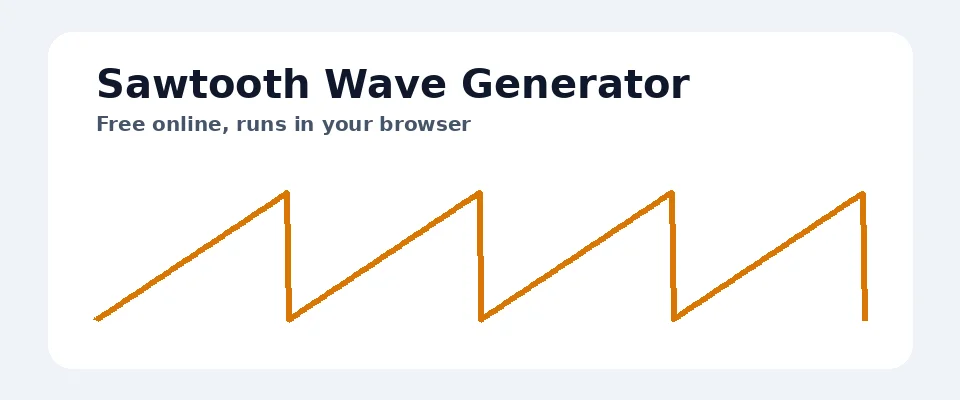
What a sawtooth wave sounds like: Every harmonic, the brightest wave
A sawtooth wave ramps up and drops sharply. It contains all harmonics, which makes it rich and bright, the classic raw material for synth strings, brass and leads. Its strong upper harmonics also make it a quick check for treble response.
Compare all four waveforms
Sine wave
A single pure frequency with no harmonics. It sounds smooth and clean, which makes it the standard for hearing checks, speaker tests and finding resonances.
Square wave
Contains the fundamental plus odd harmonics. It sounds hollow and buzzy, like an old video game, and is useful for checking distortion and transient response.
Sawtooth wave
Contains every harmonic, so it is the brightest and harshest wave. It is the classic starting point for synthesizer sounds and for checking treble response.
Triangle wave
Has odd harmonics that fade quickly, so it sounds soft and flute-like, between a sine and a square wave.
Frequency range explained: from 1 Hz to 22 kHz
Hertz (Hz) means cycles per second. Human hearing is usually quoted as roughly 20 Hz to 20,000 Hz (20 kHz), but most adults hear less at the top end, often 15–17 kHz, and the limit drops with age and noise exposure. Below about 20 Hz a tone is felt more than heard, and many phone and laptop speakers cannot reproduce anything under 100–200 Hz at all.
Bass, mids and treble
Roughly: sub-bass 20–60 Hz, bass 60–250 Hz, midrange 250 Hz–4 kHz (where speech lives and where the ear is most sensitive), and treble 4–20 kHz. Because the ear is most sensitive around 2–5 kHz, tones there sound louder than bass tones at the same volume setting.
Why the slider is logarithmic
Each octave doubles the frequency (100 → 200 → 400 Hz). A logarithmic slider gives every octave the same amount of travel, so you can set low frequencies precisely instead of squeezing 20–1,000 Hz into the first few pixels.
How to use the sawtooth wave generator
- Turn your volume down first, then press Play. The tool starts at 20% volume.
- Set the frequency: type a value in Hz, drag the slider, use the ‹ › arrows (step size 0.1–100 Hz) or tap a preset.
- Pick a waveform: sine, square, sawtooth or triangle. Changes apply instantly with a smooth fade.
- Route the sound with L/R (both, left, right), mute it, or press Share to copy a link to this exact tone.
Keyboard: Space plays/stops, ←/→ step the frequency, hold Shift for ten times the step.
More free audio tools
Hearing and speaker safety
Start with the volume low and raise it slowly. Tones are more tiring than music because all the energy sits at one frequency. Very low tones (below about 40 Hz) can push small speakers and laptop drivers past their limits, and very high tones (above about 15 kHz) can be loud even when you can barely hear them. Take breaks, never test at a level that is uncomfortable, and stop if you notice ringing, pain or rattling.
This site is a sound tool for testing, tuning and experimenting. It is not a medical device and does not diagnose, treat or prevent any condition. If you are worried about your hearing or tinnitus, talk to an audiologist or doctor.
Sawtooth wave generator FAQ
What is a sawtooth wave?
A sawtooth wave ramps up and drops sharply. It contains all harmonics, which makes it rich and bright, the classic raw material for synth strings, brass and leads. Its strong upper harmonics also make it a quick check for treble response.
Is this tone generator free?
Yes. It runs in your browser with the Web Audio API, needs no sign-up or download and sends no audio anywhere.
Why can't I hear anything?
Check that the volume slider and your device volume are up a little, that the tab is not muted, and on iPhone that the ring/silent switch is not on silent. Very low (under ~40 Hz) and very high (over ~15 kHz) tones may simply be outside what your speakers or ears can reproduce.
Can I change the frequency while the tone is playing?
Yes. The number box, slider, arrows, presets and waveform buttons all update the running tone live with a short glide, so there are no clicks.
How do I share a tone?
Press Share. It copies a link like ?f=440&w=sine that opens the generator with the same frequency and waveform.
What does the L/R button do?
It cycles the output between both channels, left only and right only, which is handy for checking stereo wiring or one earbud at a time.
Is it safe to listen to tones?
At low volume, yes for most people. Keep the level comfortable, take breaks and avoid loud very low or very high tones. This tool is not a medical device and makes no health claims.